

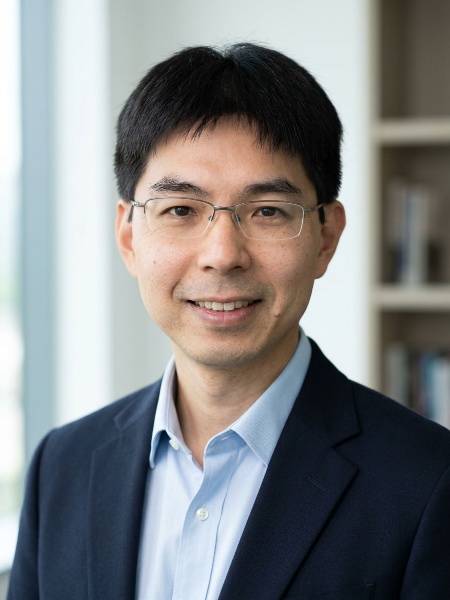
Yik-Chung Wu
The University of Hong Kong, Hong Kong SAR, China
Yik-Chung Wu received the B.Eng. (EEE) degree in 1998 and the M.Phil. degree in 2001 from the University of Hong Kong (HKU). He received the Croucher Foundation scholarship in 2002 to study Ph.D. degree at Texas A&M University, College Station, and graduated in 2005. From August 2005 to August 2006, he was with the Thomson Corporate Research, Princeton, NJ, as a Member of Technical Staff. Since September 2006, he has been with HKU, currently as an Associate Professor. He was a visiting scholar at Princeton University, in summers of 2015 and 2017. His research interests are in general areas of signal processing and communication systems, and in particular Bayesian inference, distributed algorithms, and large-scale optimization. Dr. Wu served as an Editor for IEEE Communications Letters, and IEEE Transactions on Communications. He is currently a Senior Area Editor for IEEE Transactions on Signal Processing, an Associate Editor for IEEE Wireless Communications Letters, and an Editor for Journal of Communications and Networks. He received four best paper awards in international conferences, with the most recent one from IEEE International Conference on Communications (ICC) 2020. He was a symposium chair for many international conferences, including IEEE International Conference on Communications (ICC) 2023 and IEEE Globecom 2025. He was elected the Best Editor of the year 2023 in IEEE Wireless Communications Letters. He is an elected member of IEEE signal processing society SPCOM Technical Committee (2025-2026), and an IEEE Vehicular Technology Society (VTS) Distinguished Lecturer (2025 class).
Integrated Sensing and Communication (ISAC) is a cornerstone technology for 6G networks, yet securing ISAC transmissions under practical channel state information (CSI) uncertainty remains a critical challenge. Existing resource allocation strategies are heavily fragmented—requiring custom optimization methods for different user fairness criteria and distinct sensing requirements. In this talk, we present a novel, unified optimization framework that holistically addresses both worst-case user secrecy rate and weighted sum secrecy rate under arbitrary physical layer security constraints. Unlike conventional conservative approximations, our approach precisely controls secrecy outage probabilities (SOP) under statistical CSI, leaving maximum power resources for performance optimization. Furthermore, by moving complex sensing metrics into the objective via penalty variables, our framework handles diverse requirements (such as SINR, beampattern matching, and detection probability) within a single gradient-based alternating optimization routine. We demonstrate theoretical guarantees of convergence to stationary points and highlight simulation results showing superior secrecy rates and significantly lower computational overhead compared to existing baseline methods.