

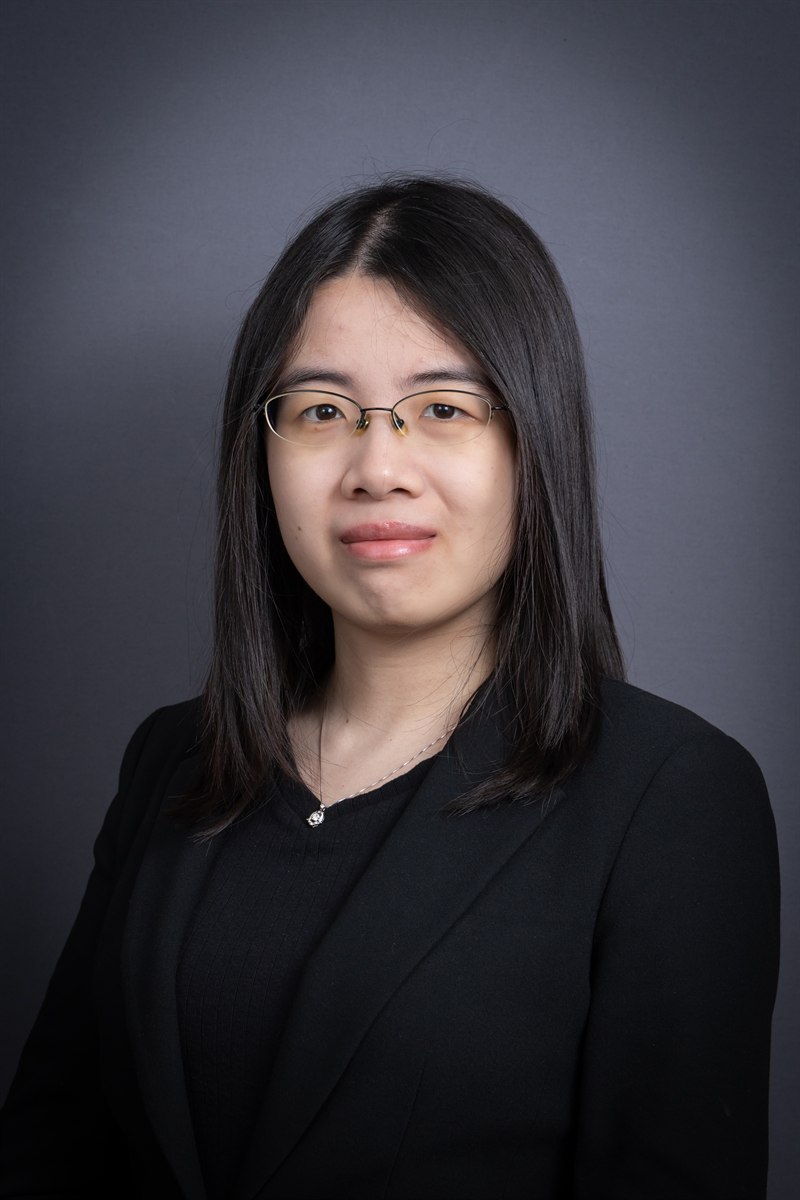
Shuowen Zhang
The Hong Kong Polytechnic University, Hong Kong SAR, China
Shuowen Zhang (Senior Member, IEEE) received the B.Eng. degree in information engineering from the Chien-Shiung Wu Honors College, Southeast University, Nanjing, China, in June 2013, and the Ph.D. degree from NUS Graduate School for Integrative Sciences and Engineering (NGS), National University of Singapore, in January 2018 under the NGS scholarship. From February 2018 to July 2020, she was a Research Fellow with the Department of Electrical and Computer Engineering, National University of Singapore. Since August 2020, she has been with The Hong Kong Polytechnic University, where she is currently an Assistant Professor at the Department of Electrical and Electronic Engineering. Her research interests include integrated sensing and communication, intelligent reflecting surface aided communication, unmanned aerial vehicles, multiple-input multiple-output (MIMO), and communication theory. Prof. Zhang is currently serving as an Editor for IEEE Transactions on Wireless Communications and an Associate Editor for IEEE Transactions on Mobile Computing. She has served as a Guest Editor for various journals such as the IEEE Journal on Selected Areas in Communications. She has also served as an IEEE Communications Society Asia-Pacific Board WICE Vice Chair and an IEEE/ACM N2Women Mentoring Co-Chair. Prof. Zhang is the sole recipient of the 2021 Marconi Society Paul Baran Young Scholar Award and the 2025 IEEE Communications Society Communication Theory Technical Committee (CTTC) Early Achievement Award, as well as a recipient of the 2022 IEEE Communications Society Young Author Best Paper Award (as first author), the 2023 IEEE Communications Society Best Tutorial Paper Award (as second author), the 2023 PolyU Young Innovative Researcher Award, and the 2024 IEEE Communications Society Asia-Pacific Outstanding Young Researcher Award. She is an IEEE Communications Society Distinguished Lecturer.
In wireless sensing or integrated sensing and communication (ISAC) systems, the exact values of the parameters to be sensed are generally unknown before sensing is performed. This leads to unknown channels associated with the sensing targets, which pose new challenges for the beamforming design. On the other hand, the distribution of the parameters to be sensed can be practically acquired a priori based on target properties or statistical analysis. This talk will present a new beamforming optimization framework for wireless sensing or ISAC systems based only on the prior distribution information about the parameters to be sensed. Specifically, we are going to discuss a series of interesting questions as follows. Firstly, for a sensing-only system, with various possible values for each parameter to be sensed, each with a potentially different probability, how to design transmit beamforming and how many sensing beams are needed? We will unveil a novel "probability-dependent power focusing" effect in the optimized beamforming design. Secondly, for an ISAC system with dual-functional beams for sensing and communication, how many dual-functional beams are needed for achieving an optimal trade-off between sensing and communication? Thirdly, for an ISAC system with potentially dedicated sensing beams, when are sensing beams needed and how many sensing beams are needed? Finally, we will reveal the role of such prior distribution information in various other practical problems such as the placement design of sensing anchors as well as the beamforming designs in systems with limited radio frequency (RF) chains, reconfigurable surface, physical-layer security consideration, or networked sensing.